Pages

KRINVANTO VISHWAM ARYAM – MAKE THE UNIVERSE NOBLE

http://img145.imageshack.us/img145/2153/001zq.jpg


Write of BK Barman about Arya Samaj Organisation

Sunday, March 2, 2014


READ MORE - Write of BK Barman about Arya Samaj Organisation

Member of Arya Pratinidhi Sabha Bengal,(At the time of B K Barman was President )


READ MORE - Member of Arya Pratinidhi Sabha Bengal,(At the time of B K Barman was President )

India

Tuesday, July 3, 2012


"We owe a lot to the Indians, who taught us how to count, without which no worthwhile scientific discovery could have been made."
Albert Einstein

The beautiful subcontinent of India lies in south Asia, between Pakistan, China and Nepal. To the north it is bordered by the world's highest mountain chain, “The Himalayas”. It has plateaus, tropical rain forests, sandy deserts and is bordered by palm fringed beaches. Just like the staggering topographical variations it has its cultural diversity. One one hand India has the towering temples of south India and on the other in the desert of Kutch, Gujarat, a scattering of villages stand stoutly against the awesome forces of nature, resulting in Spartan lifestyles made vibrant by a colorful jewelry and embroidery of clothes. In the extreme north is the high altitude desert of Ladakh where local culture is shaped by the faith (Buddhism) and by the harsh terrain. On East corner live the tribes of the north eastern states of Nagaland, Mizoram, Tripura and Manipur with their colorful folk culture.
India's history goes back to several thousand years BC when Hinduism was first founded. Buddhism, Jainism, Sikhism all were founded in India. Today India has true multi religional face as Hinduism, Jainism, Islam, Christianity, Sikhism and Buddhism all exist in harmony. Modern India is home alike to the tribals and to the sophisticated urban jetsetters. It is a land where elephants and cars both travel on road amicably.

National Flag
India’s National flag is a horizontal tricolor of deep saffron (kesari) at the top, white in the middle and dark green at the bottom in equal proportion. It is called “Tiranga Jhanda”. The ratio of width of the flag to its length is 2:3. In the centre of the white band is a navy blue wheel, which represents the Ashoka Chakra. Its diameter approximates to the width of the white band and it has 24 spokes.

National Anthem
The song “Jana-gana-mana”, composed originally in Bengali by Rabindranath Tagore, was adopted in its Hindi version as the national anthem of India. It was first sung on 27 December 1911 at the Calcutta Session of the Indian National Congress. The complete song has five stanzas but only the first stanza was adopted as National anthem.

Jana-gana-mana-adhinayaka, jaya he
Bharata-bhagya-vidhata.
Punjab-Sindh-Gujarat-Maratha
Dravida-Utkala-Banga
Vindhya-Himachala-Yamuna-Ganga
Uchchala-Jaladhi-taranga.
Tava shubha name jage,
Tava shubha asisa mage,
Gahe tava jaya gatha,
Jana-gana-mangala-dayaka jaya he
Bharata-bhagya-vidhata.
Jaya he, jaya he, jaya he,
Jaya jaya jaya, jaya he! 

জনগণমন-অধিনায়ক জয় হে.
ভারতভাগ্যবিধাতা
পঞ্জাব সিন্ধু গুজরাট মরাঠা
দ্রাবিড় উৎ‍‌কল বঙ্গ
বিন্ধ্য হিমাচল যমুনা গঙ্গা
উচ্ছল জলধি তরঙ্গ
তব শুভ নামে জাগে
তব শুভ আশিস মাগে
গাহে তব জয়গাথা
জনগণমঙ্গলদায়ক জয় হে
ভারতভাগ্যবিধাতা
জয় হে, জয় হে, জয় হে,
জয় জয় জয়, জয় হে॥
 
The following is Tagore’s English rendering of the anthem:

Thou art the ruler of the minds of all people,
dispenser of India’s destiny.
Thy name rouses the hearts of Punjab, Sind, Gujarat and Maratha,
Of the Dravida and Orissa and Bengal;
It echoes in the hills of the Vindyas and Himalayas, mingles in the music of Jamuna and Ganges
and is chanted by the waves of the Indian Sea.
They pray for thy blessings and sing thy praise.
The saving of all people waits in thy hand,
thou dispenser of India’s destiny.
Victory, victory, victory to thee.


National Emblem
The State emblem is an adaptation from the “Sarnath Lion” Capital of Ashoka. In the State emblem, only three lions are visible, the fourth being hidden from view. The wheel appears in relief in the centre of the abacus with a bull on right and a horse on left and the outlines of other wheels on extreme right and left. The words Satyameva Jayate from Mundaka Upanishad, meaning ‘Truth Alone Triumphs’, are inscribed below the abacus in Devanagari script.

NATIONAL SONG
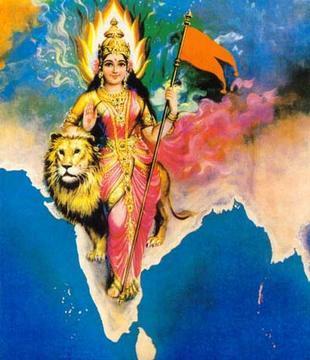
The song “Vande Mataram”, composed in Sanskrit by Bankimchandra Chatterji, was a source of inspiration to the people in their struggle for freedom. It has an equal status with “Jana-gana-mana”. The first political occasion when it was sung was the 1896 session of the Indian National Congress. Only the first 2 stanzas are adopted as national song. The following is the text of this song in original.
Vande Mataram!
Sujalam, suphalam, malayaja shitalam,
Shasyashyamalam, Mataram!
Shubhrajyothsna pulakitayaminim,
Phullakusumita drumadala shobhinim,
Suhasinim sumadhura bhashinim,
Sukhadam varadam, Mataram!
Vande Mataram!

Following is the English translation of the stanza rendered by Sri Aurobindo.

I bow to thee, Mother,
richly-watered, richly-fruited, cool with the winds of the south,
dark with the crops of the harvests, The Mother!
Her nights rejoicing in the glory of the moonlight,
her lands clothed beautifully with her trees in flowering bloom,
sweet of laughter, sweet of speech,
The Mother, giver of boons, giver of bliss.


National Animal
The magnificent tiger, Panthera Tigris (Linnaeus), is a striped animal. It has a thick yellow coat of fur with dark stripes. The combination of grace, strength, agility and enormous power has earned the tiger its pride of place as the national animal of India. Indian race, the Royal Bengal Tiger, is found throughout the country except in the north-western region and also in the neighboring countries, Nepal, Bhutan and Bangladesh.


National Bird
The Indian peacock is the national bird of India. It is a colorful, swan-sized bird, with a fan-shaped crest of feathers, a white patch under the eye and a long, slender neck. The male of the species is more colorful than the female, with a glistening blue breast and neck and a spectacular bronze-green train of around 200 elongated feathers. The elaborate courtship dance of the male, fanning out the tail and preening its feathers, is a gorgeous sight. The peacock is widely found in the Indian sub-continent. The Peacock enjoys protection from the people as it is never molested for religious and sentimental reasons.

National Flower
Lotus is the National Flower of India. It is a sacred flower and occupies a unique position in the art and mythology of ancient India and has been an auspicious symbol of Indian culture since time immemorial.

National Languages
Hindi is the official and main link language of India. Its homeland is mainly in the north of India, but it is spoken and widely understood in all urban centers of India. It is written in the Devanagri script, which is phonetic and, unlike English, is pronounced as it is written. Hindi is a direct descendant of Sanskrit through Prakrit and Apabhramsha. It has been influenced and enriched by Dravidian, Turkish, Farsi, Arabic, Portugese and English.
In all there are 22 languages recognized by the Indian Constitution. These languages are
  • Assamese
  • Bengali
  • Bodo
  • Dogri
  • Gujarati
  • Hindi
  • Kannada
  • Kashmiri
  • Konkani
  • Maithili
  • Malayalam
  • Manipuri
  • Marathi
  • Nepali
  • Oriya
  • Punjabi
  • Sanskrit
  • Santhali
  • Sindhi
  • Tamil
  • Telugu
  • Urdu
National Fruit
A fleshy fruit, eaten ripe or used green for pickles etc., of the tree Mangifera indica, the mango is one of the most important and widely cultivated fruits of the tropical world. Its juicy fruit is a rich source of Vitamins A, C and D. In India there are over 100 varieties of mangoes, in different sizes, shapes and colours. Mangoes have been cultivated in India from time immemorial. 

National Calendar
The national calendar is based on the Shaka Era with Chaitra as its first month. A normal year of 365 days was adopted from 22 March 1957 along with the Gregorian calendar. Dates of the national calendar have a permanent correspondence with dates of the Gregorian calendar: 1 Chaitra falling on 22 March normally and on 21 March in leap year.

"If there is one place on the face of the earth where all the dreams of living men have found a home from the earliest days when man began the dream of existence, it is INDIA."
 Romain Rolland, French Scholar

READ MORE - India

Gayatri Mantra

Gayatri Mantra 

There is a famous prayer in Sanskrit that first appears in the Rig Veda (iii /62/10) called the gayatri mantra that almost every Hindu knows. In roman letters it is as follows:
Om bhur bhuvah svah
tat-savitur varenyam
bhargo devasya dhimahi
dhiyo yo nah pracodayat
Mantra
Gayatri in Devanagari letters
Literally hundreds of books and thousands of web pages are currently dedicated to explaining the esoteric meaning of this mantra, so I will not repeat that discussion. Instead I will provide a basic grammatical explanation of this most famous mantra and if you are new to Hinduism and want to know at least one prayer, this is the prayer you should learn.
Gayatri is actually the name for a Sanskrit poetical meter that contains three lines of eight syllables each. There are, therefore, many gayatri mantras, but this particular one is the oldest and most well known of all gayatri mantras. In Hinduism all Gods and Goddesses have a gayatri mantra associated with them. There is a gayatri for Ganesha, one for Shiva, one for Durga, one for Vishnu, one for Lakshmi, and so on. Most people are unaware of this fact and when Hindus talk about the gayatri mantra they mean thee gayatri mantra shown above, which is addressed to Savitri, the sun. The first line: om bhur bhuvah svah that you see above is not actually part of a gayatri mantra. It is a special utterance called vyahriti that has been added to the beginning of this famous gayatri . This vyahriti is important in and of itself and we will discuss it after we have explained the basic gayatri mantra. The three lines of this gayatrimantra are:
1. tat-savitur varenyam.
2. bhargo devasya dhimahi, and
3. dhiyo yo nah pracodayat
Here is a word-for-word breakdown of the gayatri mantra that most Hindus know.
tat–that (God)
savitur–of the sun
varenyam–the best
bhargo (bhargas)–light, illumination
devasya–divine
dhimahi–let us meditate (a verb)
dhiyo (dhiyah)–thought(s)
yo (yah)–which
nah–of us, our
pracodayat–May it push, inspire (a verb)
Savitri: the Sunrise
The deity associated with this gayatri mantra, as we mentioned, is the sun,savitri. (The second word of this mantra.) The more common name for the sun issurya. Generally "surya" is the name for the sun while it is above the horizon andsavitri is the sun as it is rising and setting, just below the horizon. There is a great metaphor in Hinduism that when understood explains a lot about the Hindu way of seeing the universe. The metaphor is: “the sun equals light, which equals knowledge, which equals consciousness.” This metaphor applies not only to thegayatri mantra, but also to the design of temples and homes, and to details such as why we circumambulate from left to right and offer incense and lamps in a clockwise direction.
The most important word in the gayatri mantra is the word, “tat,” which is a neuter pronoun meaning “that.” It is a reference to “that One," God. According to the metaphor mentioned above, the sun, which is the source of illumination, heat, food and so many other things in our life, can naturally be seen as the “representative” or symbol of God in this world. There are two verbs in the gayatri mantra, dhimahi and prachodayatDhimahi means, “let us meditate.“ So, “let us meditate on the light (bhargo) of the sun which represents God.” This is the basic meaning of the first part of the gayatri mantra.
The second part is also straight forward. The verb prachodayat literally means , “it should push,” but in more poetic language we can translate it as “let it inspire.” Dhiyah is “thoughts,” so dhiyo yo nah prachodayat means, “may our thoughts be inspired” So the most literal meaning of the gayatri mantra is, “Let us meditate on the light of the sun which represents God, and may our thoughts be inspired by that divine light.”
Gayatri Devi
Gayatri Devi
As with most things Hindu, the gayatri mantra is also personified as the Goddess, Gayatri Devi. She is the wife of Brahma and is pictured with five heads sitting on a lotus. She is the embodiment of the supreme brahman. You will also see other depictions of Gayatri Devi that vary somewhat.
The gayatri mantra is traditionally whispered into the ear of a young boy in a ceremony called The Thread Giving Ceremony (upanayana), which is one of the rites of passagefollowed by many Hindus. In addition, the gayatri mantra is repeated during daily prayers performed by many Hindus three times a day, while facing the sun: at sunrise, at noon and at sun set. It is also common to recite the gayatri as part of a havan, or to recite it in a collective way in temples or homes.


The Great Utterance
The first part of the gayatri mantra, om bhur bhuvah svah, which we mentioned at the beginning as not part of the mantra, is called vyahriti or the “great utterance.” This mantra is repeated not only in conjunction with the gayatrimantra, but also separately during havans or fire ceremonies. The word om is a auspicious sound made at the beginning of many prayers. The expression bhur bhuvah and svah is technical, but a simple way to think of it is as a “call to creation,” that the light of the sun (the light of God) shines on the earth (bhur), in the sky (bhuvah), and in space (svah), and therefore the implication is, “let that light also shine on me.”
The technical explanation vyahriti has to do with subtle practices of meditational yoga. This earth is simply one of many planes of existence. In fact, above this earth are six higher planes, heavens as it were. Including this earth, there are seven planes up (heavens) and seven planes down, or hells below this earth. The earth is in the middle. If you have ever heard the expression, “he is in seventh heaven” you should understand that this is a reference to the Hindu idea of heavens. The seventh heaven is the highest heaven. The first three of these planes starting with the earth are called bhur, bhuvah and svah. The utterance bhur bhuvah svah, therefore, refers to the first three subtle planes of existence that may be reached in meditation by a yogi.
READ MORE - Gayatri Mantra

Principles of Arya Samaj

1-Sab satya vidyaa aur jo padaartha vidyaa se jaane jaate hain un sab kaa aadimool parameshwar hai.

God is the primary cause of all Spiritual and Physical Sciences and of everything known through their means.


2-Eeshwar sachchidaananda-swaroop, niraakaar, sarvashaktimaan, nyaayakaaree, dayaalu, ajanmaa, ananta, nirvikaar, anaadi, anupama, sarvaadhaara, sarveshwara, sarva-vyaapak, sarvaantaryaamee, ajar, amar,  abhaya, nitya, pavitra aur srishtikarttaa hai. Usi kee upaasanaa karnee yogya hai.

God is Existent, Intelligent and Blissful. He is Formless, Beginningless, Incomparable, the Support and Lord of all, Omniscient, Imperishable, Immortal, Fearless, Eternal, Holy, and the Creator of the Universe. To Him alone worship is due.


3-Veda sab satya vidyaaon kaa pustak hai. Veda kaa parhnaa parhaanaa aur sunna sunaanaa sab aaryon ka param dharma hai. 

The Vedas are the scriptures of all true knowledge. It is the duty of all Aryas to read them, hear them being read and recite them to others.
4-Satya grahan karne aur asatya ke choorne mein sarvadaa udyat rahnaa chaahiye. 


One should always be prepared to accept truth and reject untruth.


5-Sab kaam dharmanusaar arthaat satya aur asatya ko vichaar karke karne chahiyein. 

All action should be performed in conformity with Dharma (righteousness), that is, after due consideration of the right and wrong.


6-Sansaar kaa upkaar karnaa is samaaj kaa mukhya uddeshya hai arthaat shareerik, aatmik aur samaajik unnati karna.

To do good to the whole world is the main objective of the Arya Samaj, that is, to improve the physical, spiritual and social well-being of all mankind.


7-Sab se preetipoorvak dharmanusaar, yathaayogya varttanaa chaahiye. 


All people should be treated with love, fairness and due regard for their merit.
8-Avidyaa ka naash aur vidyaa kee vriddhi karnee chaahiye.

 
One should always promote knowledge and dispel ignorance.


9-Pratyek ko apnee hi unnati se santushta na rahnaa chaahiye, kintu sab kee unatti mein apni unnati samjhnee chaahiye. 

One should not only be content with one's own welfare, but should look for it in the welfare of others also.


10-Sab manushyon ko samaajik sarva-hit-kaaree niyam paalne mein paratantra rahna chaahiye aur pratyek bitakaaree niyam mein sab swatantratra rahein. 

One should be bound in following altruistic, social rules, while all should be free in following the rules of individual welfare


READ MORE - Principles of Arya Samaj

Arya Samaj (Society of Nobles)

Arya Samaj (Society of Nobles) is a Hindu reform movement founded by Swami Dayananda in 1875 in India. He believed in the infallible authority of the Vedas.
The Vedas state that one formless supreme Being exists, who is omniscient, omnipotent, eternal, imperishable, benevolent, and blissful, who co-exists with prakriti or primeval energy from which the world is created It teaches love, justice and righteousness towards all, irrespective of race, caste or creed.  This is embodied in the Society's motto:
 "Krinvanto Vishvam Aryam" - "Make This World Noble".


The Arya Samaj indeed is an international movement and not a national one. Right from day one when this august movement made a debut in Bombay in 1875 the entire mankind was put in focus. Among the 28 principles enunciated at the inception and later modified to 10 principles in Lahore in 1877, the emphasis has all along been on the development of the entire mankind. The sixth principle of the Arya Samaj states that promotion of well being of the entire humanity – physical, spiritual and social development – is the main aim of the Aryan movement. It needs no underscoring that as a reformation movement the Arya Samaj is not confined to the geographical or political boundaries of a nation state. However, India being the birth place of the movement and the founder promoter of the Arya Samaj, Maharshi Swami Dayanand Saraswati, being an Indian the initial impact was felt in the then British India.


READ MORE - Arya Samaj (Society of Nobles)

MAHARISHI DAYANAND Poem By: Tilak Grover

MAHARISHI DAYANAND 
Poem By: Tilak Grover


Maharishi Dyanand writings and his work reveal,
That he was a brave person and a man of steel.
In Indian society he brought about reform after reform,
In religious debates with Pundits he did outperform.


He had fervor and zeal to fill his dream,
When he won debates on Vedic Dharma,
His arguments made so called Vedic scholars virtually scream
He broke the barrier of the dark ugly past,
Which had hideous system of the class or caste
Never did Maharishi accept the distinction of caste,
Nor did he accept the falsified interpretations of the Vedas


He had strong mind set to establish the society called Arya Samaj
Based on the ten main principles of Arya Samaj,
Which allowed untouchables to be its Samaj member
The society of the people having excellence and integrity
And the society members having no class distinction and no disparity.


The man of steel could not budge from the true meaning of Vedas
he challenged phony pundits on their falsified versions of Vedas.
In the ocean of deep oppositions he did wade through.He talked simple and straight and called a spade a spade too.


In his life he had many ups and downs
But the negative people could not let him down.
His bubbling zeal had fuel and fire to move onward
In his leadership Arya Samaj flourished straight forward.


His mind was like a running modern computer
Never let any deadly virus infiltrate into his mental computer.
Swami hard life had left us indelible impression in our mind
beloved son of India had a intense love and patriotism for the motherland. He was the best friend and Guru of Modern times in nineteenth century band.


His enthusiastic spirit created many brave heroes in our land
Swami Sharda Nand and beloved Lekh Ram of Panjab
The author of Rangila Rasool Lala Lajpat Rai, the lion of Panjab
Who sacrificed their lives for Arya Samaj and dear motherland
He stirred the languid India society rekindling the fire and zeal
Putting the Arya society on moving true Vedic wheel.


How did Mool Chand the inquisitive kid of Tankara become Maharishi Dayanand?


What incident made him Maharishi Dayanand?


When he was a child, his father told him to stay awake all night
To have face to face Shiva’s glimpse and blessing by fasting on Shivrati night. Instead he saw a mouse hoping on Shiv Linga and devouring delicious devotee’s offering the episode of Shivratri night urged him to find.


Why the tiny naughty mister mouse jumped on the body of Shiva Linga,
Who could not protect itself and the offerings of all kinds?


He was also disappointed and depressed at the death of his uncle and his dear sister which forced him to leave home to find answer to find:
What is death and what is real God?


He left home to seek truth.He did not spend another day disappointed and depressed.


At Mathura he met a genuine Guru Virja Nand, Who taught him and named him Dayanand,Thus Mool Chand the youngman of Tankara became a Maharishi, Sleeping slumbering India was awakened by the great Rishi.


Maharishi once said to the morally fallen Maharaja of Jodhpur,
in harsh and straight truthful words to mend his stitch, “A Lion should not have the company of bitch.”Maharaja mended his conduct and quit his mistress Nanni Bai vicious witch.


His straight and bold talk brought about a change in Maharaja turpitude
And changed his debased attitude.But later on Maharishi was poisoned by the friends of the mistress witch.


Due to having been poisoned several times Maharishi left this world on a Diwali Day,for India it was the painful, saddest and gloomiest day 
The devotee of truth searched for truth, lived for truth ,and died for the truth. 
READ MORE - MAHARISHI DAYANAND Poem By: Tilak Grover

Handwritten letters of Swami Dayanand Saraswati

Handwritten letters of Swami Dayanand Saraswati


READ MORE - Handwritten letters of Swami Dayanand Saraswati

Maharishi Dayanand Sketch Photo


READ MORE - Maharishi Dayanand Sketch Photo

Maharishi Swami Dayanand Saraswati


Maharishi Swami Dayanand Saraswati
Swami Dayanand (1824-1883) was the founder of the Hindu reform organization Arya Samaj, which he established on April 7th 1875, in Bombay India. He also created the 10 principles of Arya Samaj. Throughout his life, Swami Dayanand preached against many Hindu traditions which he felt were dogmatic and oppressive. These included traditions such as idol worship, caste by birth, and the exclusion of females from the study of the Vedas. One of his main messages was for Hindus to go back to the roots of their religion, which are the Vedas. By doing this, he felt that Hindus would be able to improve the depressive religious, social, political, and economic conditions prevailing in India in his times.


 Swami Dayanand was born on February 12th, 1824 in a town called Tankara in the state of Gujurat, India.
One of Swami Dayanand's major arguments for going back to the Vedas was that, in his own words " the four Vedas, the repositories of knowledge & religious truth, are the Word of God. They are absolutely free of error, & the Supreme & independent authority ". The four Vedas are; Rig Veda, Yajur Veda, Sama Veda, & Atharva Veda. To spread awareness of his movement and to revitalize Vedic knowledge, Swami Dayanand published many religious books. These include; Satyartha Prakash ( The light of Truth ), the Rig-Vedaadi, Bhasyya- Bhoomika, and Sanskar Vidhi.
Swami Dayanand preached many messages to Hindus during his lifetime. For instance, he preached that Hindus should worship just one, formless, God. He fought against polytheism by telling people the true meaning of the names of God, & established how all of them pointed at one & the same God- Paramathama, the Supreme Self. Further, Swami was " a voice against superstition, against unrighteousness, which reigned supreme in the garb of true religion, and  against a foreign rule ".
Throughout his known adult life, Swami's main message was " Back to the Vedas ". By this, Swami Dayanand meant that Hindus should stop practising beliefs such as idol worship, caste, polytheism, pantheism, untouchability, child marriages,forced widowhood, and many other practices which he felt were wrong. He challenged many of the Hindu orthodoxy if they could justify their belief in the aforementioned practices. This induced the anger and wrath of many orthodox Hindus, which subsequently led to 14 attempts at poisoning Dayanand. Miraculously, he was able to use his Yogic abilities to cure himself from the first 13 attempts. However, the 14th time proved fatal. Swami Dayanand died, and left the world with his legacy, Arya Samaj.
READ MORE - Maharishi Swami Dayanand Saraswati

Satyarth Prakash

READ MORE - Satyarth Prakash

The Light of Truth


Swami Dayanand made several changes in his approach to the work of reforming Hindu society after having visited Calcutta. The most significant of these changes was that he began lecturing in Hindi. Prior to his tour of Bengal, the Swami had always held his discourses and debates in Sanskrit. While this gained him a certain degree of respect among both the learned and the common people alike, it prevented him from spreading his message to the broader masses. The change to Hindi allowed him to attract increasingly larger following, and as a result his ideas of reform began to circulate among the lower classes of society as well.


After hearing some of Swami Dayanand's speeches delivered in Hindi at Varanasi, Raj Jaikishen Das, a native government official there, suggested that the Swami publish his ideas in a book so that they might be distributed among the public. Witnessing the slow collapse of the Vedic Schools due to a lack of a clear statement of purpose and the resultant flagging public support, Swami Dayanand recognized the potential contained in Das' suggestion and took immediate action.

From June to September 1874, Swami Dayanand dictated a comprehensive series of lectures to his scribe, Pundit Bhimsen Sharma, which dealt with his views and beliefs regarding a wide range of subjects including God, the Vedas, Dharma, the soul, science, philosophy, childrearing, education, government and the possible future of both India and the world. The resulting manuscript was eventually published under the title Satyarth Prakash or The Light of Meaning of Truth in 1875 at Varanasi. This voluminous work would prove to play a central role in the establishment and later growth of the organization which would come to be known as the Arya Samaj.

READ MORE - The Light of Truth

Saturday, January 8, 2011

Swami Agniveshji ,Sri Ram , Kalyanji & other members of Arya Samaj in 1st Jan 2011

Swami Agniveshji deliver speeches in Kolkata Arya Samaj , 1st Jan 2011
Kalyanji with Acharya Anand Puruswarthi in Kolkata Arya Samaj Sammelan Sabha

READ MORE -

Sarvyadesic Sammelan in Delhi

Thursday, October 21, 2010

Member of Kolkata Arya Samaj on the year 2009 -
From Right to Left:  President- Sri Ram Arya
Vice President - Sri K. K Barman
Secretary - Mr. T.Das
READ MORE - Sarvyadesic Sammelan in Delhi

Batakrishna,2010

Monday, July 19, 2010

READ MORE - Batakrishna,2010

Batakrishna,2009

READ MORE - Batakrishna,2009

Batakrishna,09

READ MORE - Batakrishna,09

Batakrishna,08

READ MORE - Batakrishna,08

DAYANANDA,08

READ MORE - DAYANANDA,08

The Vedas

Sunday, July 18, 2010

The Vedas


The Essence of Vedas

'Whence this creation has come into existence,
whether He established it or did not;
He who is its overseer in the higher firmament,
He verily knows or knows not…'
– The Rig-Veda (hymns to Prajapati, the creator)

Bramha Typical mind game from the subtlest and most profound of all ancient Indian, and indeed world, scriptures. This spirit of questioning is, in many ways, the essence of the Vedas, as also the age when the Aryans were finding their feet in India.

The story goes back a long time. It starts in 1200BC, when the first Aryan immigrants in India started composing the various hymns that are part of the books. They were meant to be mantras (incantations) in praise of various Aryan gods. What they also reflect is a startlingly vivid picture of life, as was being led by the Aryans who came to India. Things move along as they trace the settling down of the Aryans in their new habitat and the various changes that invariably happened in their society.

There are four Vedas:

The Rig-Veda:- The date for the Rig-Veda was in controversy for a long time. The traditional date goes back to 3000BC, something which the German scholar Max Mueller accepted. However, modern historians have now reached a consensus that its oldest parts were written around a more cautious 1200BC.

As a body of writing, the Rig-Veda (the wisdom of verses) is nothing short of remarkable. It contains 1028 hymns dedicated to thirty-three different gods; these gods were, quite expectedly, nature gods. The most often addressed gods are Indra (rain god; king of heavens), Agni (fire god) and Rudra (storm god; the 'howler'). A sizeable chunk of the verses are also dedicated to Soma (the draught of immortality), which was a cool alcoholic brew made from the leaves of the soma plant and was drunk during sacrifices. The identity of the plant itself is subject of furious debate. In nature, however, it was somewhat similar to the brews that the American Indians used to consume before conducting sacrifices – to numb both the sacrificer and the sacrificee although human sacrifice was never a part of Aryan worship.

This oldest religious text in the world has10,589 verses which are divided into ten mandalas or book-sections. The oldest portions of the Rig-Veda are from books two to seven; the others were added later. The book-sections are arranged according to the number of hymns they possess.

The Sama-Veda:- The Sama-Veda or the wisdom of chants is basically a collection of samans or chants, derived from the eighth and ninth books of the 'original Veda', the Rig-Veda. These were meant for the priests who officiated at the rituals of the soma ceremonies – in full sway there could have as many as seventeen full rituals. As time went along rituals and ceremonies of worship became increasingly intricate and the simplicity of the original Rig-Vedic age was slowly forgotten. Thus a need arose to compile all the rituals and their chants in a book, as a sort of reference point for the priests whose functions this Veda clearly puts down.

It is not surprising that the Sama-Veda is better known for the precise meter of its poetry than for its literary content. There are also painstaking instructions in Sama-Veda about how particular hymns must be sung; this is perhaps because great emphasis was put upon sounds of the words of the mantras and the effect they could have on the environment and the person who pronounced them.

The Yajur-Veda:- The Yajur-Veda or the wisdom of sacrifices lays down various sacred invocations (yajurs) which were chanted by a particular sect of priests called adhvaryu. They performed the sacrificial rites. This is very much a ritual based Veda for although there are a few hymns to various Gods the main stress is on the theory of the ritual. The Veda also outlines various chants which should be sung to pray and pay respects to the various instruments which are involved in the sacrifice.

The Atharva-Veda:- The Atharva-Veda (the wisdom of the Atharvans) is called so because the families of the atharvan sect of the Brahmins have traditionally been credited with the composition of the Vedas. It is a compilation of hymns but lacks the awesome grandeur which makes the Rig-Veda such a breathtaking spiritual experience. It is roughly equivalent to the western magic spells and has incantations for everything – from success in love to the realization of otherworldly ambitions.
READ MORE - The Vedas


Wallpaper

[gayitri+mantra++.JPG][dadu.jpg]https://blogger.googleusercontent.com/img/b/R29vZ2xl/AVvXsEhlKUlU_s8dpfIC_7jMoKCuZEEg94h5QU5vdl9ws5eusJFkxEzj25kz5e8gC_Er7AcFnG1FSFzSsVTmGqJ-gBYyrfp2L-TU3nlBdEOdRHd5wjUh8T2njphRfn97b2Z20ZbJDdG1HPMrx5Fq/s1600/Untitled-1+copy+(Large).jpg